Job Interviews
How To Face A Blind Interview

The interview landscape varies:
The Ideal Scenario: Having a connection within the company, or even on the interview panel, can offer insight and advocacy.
The Common Reality: Most applicants start with only basic knowledge, the company's name and the position's requirements.
This disparity highlights a critical skill for job seekers: the ability to transform limited public information into a compelling, personalized case for your candidacy.

A "blind interview" refers to a situation where you have minimal information about the company or the specific role beforehand. If you find yourself in this position, preparation becomes even more crucial. Begin by dressing professionally; your attire is a non-verbal communication of your judgment and respect for the opportunity. Beyond that, focus your preparation on universal interview strengths: articulate your skills and experiences clearly, prepare insightful questions about the company's challenges and culture, and demonstrate your adaptability and critical thinking. This approach allows you to navigate the unknown with confidence and make a strong, positive impression.

We Are Helping 1000 Businesses Amplify Their Online Presence
While a suit is often recommended for interviews, it’s not a one-size-fits-all rule. Appropriate attire ultimately depends on the company’s culture and the specific role you’re pursuing.

Job Interviews Body Language
Your interview attire should signal that you can seamlessly step into the role. For a corporate management position, a suit is typically expected. For a hands-on role like a warehouse worker, prioritize neat, practical clothing that shows you're ready for the job's physical demands.
Something like slacks and loafers would do instead of jeans and snickers. One important thing to remember before going for a blind interview is to prepare well for it.
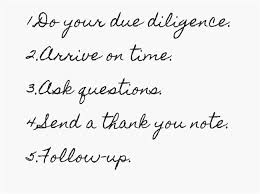
Job Interviews - Impression
Prepare Thoroughly for Effective Job Interview
This is a crucial and often overlooked part of interview preparation. Here is an actionable plan to research a company and formulate insightful questions.
Phase 1: Deep Research (Before the Interview)
Your goal is to move from basic facts to strategic understanding.
1. Start with the Official Story:
Website: Thoroughly read the "About Us," "Mission & Values," "History," and "Team/Leadership" pages. Note the language they use.
Press/News Room: Look for recent announcements (product launches, expansions, partnerships, awards).
Careers Page: Especially the section about "Culture" or "Life at [Company]." This tells you what they're proud of.
Blog & Social Media (LinkedIn, Twitter/ X): Understand their voice, recent content focuses, and how they engage with their community.
2. Understand the Business & Industry:
What do they actually do? Describe their products/services in your own words. Who are their customers (B2B or B2C)?
Business Model: How do they make money?
Competitors: Identify 2-3 main competitors. This gives you industry context.
Recent News: Use Google News with the company name. Look for:
Growth: New funding, IPOs, profitability milestones.
Challenges: Market shifts, layoffs (reported responsibly), controversies.
Strategy: New market entries, key hires, major projects.
3. Decode Culture & Reputation:
Review Sites (Glassdoor, Blind): Read for patterns, not just extremes. Look for consistent praise ("great work-life balance") or complaints ("slow promotion"). This can hint at real culture.
LinkedIn: Look at profiles of people who work there, especially in roles similar to yours. What projects do they highlight? How long do they stay?
4. Synthesize Your Research:
Answer these questions for yourself:
How long have they been in business? (This is your basic fact. A 5-year-old startup vs. a 100-year-old conglomerate face different challenges).
What is important to them (now)? This is the key insight. Is it:
Growth & Market Share? (Aggressive hiring, launching new products).
Innovation & Technology? (Patents, R&D focus).
Customer Experience & Satisfaction? (Net Promoter Score, service awards).
Culture & Employee Development? (Promoting from within, training programs).
Stability & Operational Excellence? (Process optimization, efficiency).
What are their likely current challenges? Based on industry news, competitor moves, or economic conditions.

Phase 2: Connecting to "How You Can Help Them"
This is where you turn research into your value proposition. For each "what's important" or "challenge" you identified, prepare a brief statement or anecdote from your experience.
If growth is key: "I saw on your news page you're expanding into the European market. In my last role, I helped launch our product in two new countries by leading the localized marketing campaigns, which is an experience I could leverage here."
If innovation is key: "I'm impressed by your investment in AI for your platform. My background in data analysis and process automation aligns directly with pushing forward those kinds of innovative projects."
If culture is key: "I've read about your peer-recognition programs. Building collaborative teams is something I'm passionate about; in my last project, I instituted a weekly knowledge-share that improved cross-department alignment."
Phase 3: Preparing Your Questions for the Interview
Ask questions that show you've done your homework and think strategically. Avoid questions easily answered on the website (e.g., "What do you do?").
Categories of Great Questions to Ask:
A. Questions about the Role's Impact & Success (Shows you're results-oriented):
1. "What are the key metrics or outcomes you'd like this role to achieve in the first 6-12 months?"
2. "What's the most pressing challenge the person in this role would need to tackle in the first 30 days?"
3. "How does this team/department contribute to the company's key goals this year? [Mention a goal you read about, e.g., '...like the expansion into X market you announced']?"
B. Questions about Culture & Dynamics (Shows you're a cultural fit):
4. "What's your favorite part about the culture here that isn't written on the website?"
5. "How would you describe the working and communication style of the team this role will be part of?"
6. "Can you tell me about a time when someone on your team did something exceptional? How was that recognized?" (This reveals what they truly value).
C. Questions about Growth & Development (Shows you're ambitious and long-term thinking):
7. "What opportunities for learning and development are typically available for someone in this role?"
8. "Looking at the career paths of people who've excelled in this role before, where have they progressed within the company?"
D. A Strategic Forward-Looking Question (Shows high-level thinking):
9. "I read about [Industry Trend/Competitor Move]. How is the company thinking about adapting or seizing opportunities in that area?"
Final Tip: Listen actively to their answers. Your follow-up comments ("That aligns well with my experience in...") are where the real connection happens. By doing this deep work, you transform from an interviewee reciting a resume into a strategic problem-solver they can see on their team.

How to Shine in a Blind Interview: Show Enthusiasm and Find Alignment
A "blind interview," where you have minimal details about the role beforehand, is a unique opportunity to demonstrate your adaptability and inquisitive nature. Your success hinges on two active goals: expressing genuine enthusiasm and proactively uncovering the role's core needs to ensure mutual fit.
Here’s how to put that into practice:
1. Lead with Enthusiastic Curiosity
Your energy and interest are your biggest assets. Frame every question and response with positive engagement.
Instead of: "So, what does this job involve?"
Try: "I'm truly excited by the possibility of contributing to [Company's Mission/Project Area]. From what I've gathered, your work in [Specific Field] is really innovating. I’d love to hear more about what this team is focused on right now and how this role is key to driving that forward."
Key Phrases: "That sounds fascinating!", "I'm very enthusiastic about the direction you've described," "I'm keen to understand more about..."
2. Proactively Clarify Expectations with Strategic Questions
Direct the conversation toward discovering the problems they need to solve and the outcomes they desire. This shows you think like an owner.
Ask questions like:
"To help me understand the scope, what would you say are the top 2-3 priorities for this role in the first 6 months?"
"What does ‘success’ look like for this position in one year? What key metrics or achievements would define that?"
"Could you describe the biggest challenge the team or this role is currently facing that the ideal candidate would help overcome?"
3. Demonstrate Fit in Real-Time (The "Live Sample")
As you learn more, connect your skills directly to their stated needs. This turns the interview into a collaborative fit-assessment.
Listen for Keywords: If they emphasize "cross-functional collaboration," respond with: "You mentioned collaboration is crucial—in my previous role, I consistently bridged gaps between the design and engineering teams by [give a specific example]. I’m very confident in my ability to integrate quickly and be a connective tissue here."
Connect the Dots: "Given that you need someone to streamline the reporting process, my experience in automating data workflows with [Specific Tool] could be immediately applicable. I'd be thrilled to bring that expertise here."
4. Confirm Cultural and Values Alignment
Success isn't just about skills; it's about thriving within their environment.
"To ensure I could hit the ground running and contribute positively, could you describe the team's working style and the company culture? What kind of working style tends to thrive here?"
"What do you enjoy most about the culture here that you hope a new hire will also appreciate and contribute to?"
Why This Approach Works:
It transforms a blind interview from a passive Q&A into a dynamic, solution-oriented conversation. You’re not just answering questions, you're actively diagnosing a need and positioning yourself as the solution, all while showcasing the enthusiasm and strategic thinking that makes a candidate unforgettable. This not only proves you can handle ambiguity but also that you are genuinely invested in finding a role where you can deliver meaningful impact.
Remember: Your goal is to walk out of that interview with a clear picture of the role and for them to have a clear picture of you as the enthusiastic, capable problem-solver they’ve been looking for. Good luck
The Significance Of A Thank You Letter
Tips And Advice For The Right Career Path
How To Create A List Of Warm Contacts
Browse All Our Informative Topics
InternetBusinessIdeas-Viralmarketing Home Page
Tweet
Follow @Charlesfrize