Self Improvement

Beyond the Guru: Finding Yourself in Art

There is no doubt about it: self-improvement is big business. Wherever we look, we see men in sharp suits with expensive haircuts, sporting tiny earpieces, addressing audiences as if at a shareholder meeting for their multinational self-development brands.
They deal in seductive soundbites: “I’m going to show you how to get rich in thirty days!” or “Just follow my foolproof plan, no thinking required!” Success, they promise, is a certainty.
But is genuine self-development really a sure thing? If you believe, as I do, that self-development is a lifelong journey with no final destination, then you know the only certainty is uncertainty. The path involves more stumbles than victories, more loss than gain, and more self-doubt than we think we can bear. To truly improve, we must challenge the habits and assumptions we’ve accumulated over the years. This requires stepping onto a precarious limb, with no guarantee of reward, a prospect no commercial success plan would ever endorse.

So, if we cannot rely on the gurus, where can we turn?
I believe the answer lies with those who have spent millennia exploring the full spectrum of human experience: the artists. They didn’t always find easy answers, but they possessed something the gurus package and sell: courage.
Consider the visual arts. How can a painting guide us toward self-betterment? Some artworks offer serenity and introspection. I feel this whenever I view the Impressionists, particularly the intimate domestic scenes of Berthe Morisot. During her lifetime, Morisot was often dismissed as a "feminine" painter because she focused on women, children, and everyday life. Her works, however, are intensely personal and quietly revolutionary. She is a testament to pursuing what is meaningful, even when the world refuses to pay attention. Her resilience reminds us that external validation is not a prerequisite for internal growth.
Then there is Jackson Pollock. I once dismissed abstract art as little more than random splatters. My assumptions were shattered when I stood before his canvases. The energy, complexity, and sheer physicality of his work challenged everything I thought I knew about art. The search for our inner selves operates the same way: it demands that we confront and dismantle our preconceived notions, just as Pollock dismantled traditional composition.

Music, perhaps the most accessible art form, serves as an immediate catalyst for emotional discovery. How often does a single piece alter our mood, sparking happiness, relaxation, or hope? For me, Beethoven’s compositions encompass all of these. His music was a relentless pursuit of perfection, a search for redemption through sound. He spent much of his life isolated and tormented, yet his unwavering conviction transformed his suffering into something sublime that continues to enrich millions. His final words, "Applaud, my friends, the comedy is over," reflect a man who faced life, and its end, with profound honesty.
Perhaps our greatest guides are the writers. Literature has helped countless readers navigate the labyrinth of the self. To name every author who has illuminated my path would be impossible, but I will offer one piece of advice: read. If you are unsure where to begin, visit a library. Tell a librarian what you yearn to feel or understand; their expertise is a bridge to new worlds. If you cannot visit in person, join an online reading community. I have consistently found that those who love literature take genuine joy in sharing it.
So, set aside the high-pressure seminars, the aggressive success manuals, and the digital downoads promising shortcuts to greatness. Instead, stand before a painting that unsettles you. Lie on the floor and let a symphony wash over you, dance to it, weep to it, let it move you in ways you cannot explain. Curl up with a novel that transports you to a reality you never imagined.
You may not arrive at the destination the gurus promised. But art, in all its imperfect, courageous, and transcendent forms, will walk with you every step of the way.

Overthinking: The Art of Creating Problems That Weren’t There
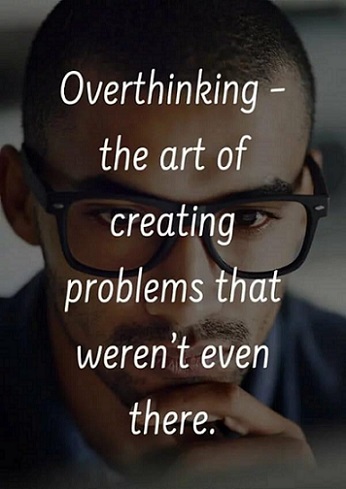
Overthinking is like a mental treadmill, you expend a lot of energy but go nowhere.
It’s the habit of excessively analyzing, doubting, or worrying about situations, often leading to stress, anxiety, and even paralysis in decision-making.
Instead of solving problems, overthinking creates them, turning minor concerns into overwhelming obstacles.
Why Do People Overthink?
Overthinking often stems from:
- Fear of failure – Worrying about making the wrong choice.
- Perfectionism – Believing there’s only one "right" decision.
- Past trauma – Previous negative experiences fuel excessive caution.
- Lack of control – Overanalyzing to regain a sense of security.
Examples of Overthinking in Real Life
1. Career Decisions
Scenario: A job offer comes with a higher salary but requires relocation.
Overthinker’s Thought Process:
- "What if I hate the new city?"
- "What if the company downsizes in a year?"
- "What if my current employer offers me a promotion later?"
Result: Instead of weighing pros and cons logically, they spiral into endless "what-ifs," leading to indecision and missed opportunities.

2. Relationships
Scenario: A partner takes a few extra hours to reply to a text.
Overthinker’s Thought Process:
- "Are they mad at me?"
- "Did I say something wrong?"
- "Maybe they’re losing interest."
Result: They create unnecessary tension by assuming the worst, possibly leading to confrontations over imagined slights.
3. Social Interactions
Scenario: After a casual conversation, someone wonders, "Did I sound stupid?"
Overthinker’s Thought Process:
- Replays the conversation repeatedly.
- Imagines the other person judging them.
- Avoids future interactions due to self-doubt.
Result: Social anxiety grows, making future interactions more stressful.
How to Stop Overthinking
1. Set Time Limits for Decisions – Give yourself 10 minutes to weigh options, then act.
2. Focus on Solutions, Not Problems – Ask, "What can I do about this?" instead of "What if?"
3. Practice Mindfulness – Meditation and deep breathing can ground you in the present.
4. Challenge Negative Thoughts – Ask, "Is this worry based on facts or fears?"
5. Accept Imperfection – Not every decision needs to be flawless.
Final Thought
Overthinking doesn’t prevent problems, it magnifies them. By recognizing when you’re spiraling into unnecessary analysis, you can train your mind to focus on action rather than endless speculation. As the saying goes, "Worrying is like paying a debt you don’t owe." Break the cycle, trust your judgment, and move forward.
20 Ways Of Training The Mind On Positive Thinking

Self improvement: 20 Ways Of Training The Mind On Positive Thinking
1. Start the day with cheers and smiles. Your whole day depends on how you greet the morning. Therefore, as long as you welcome it with energy and high spirits, everything will go okay. You don’t want the rest of the day to get ruined, do you? Come on, smile! It doesn’t cost anything but is worth everything.
2. Ask for guidance. Only the Creative Force knows what we will be having on the day ahead of us. He will surely appreciate a few minutes of praying and asking for guidance from Him. Also, have faith in Him that He is more than willing to grant our requests as long as it is for our own good. With God as our guide, we don’t have any reason not to say and believe in the thought that I can do this. I can make it through this day. Nothing is impossible. After all, God is with me.

3. Plan the day ahead. To avoid mistakes that will cause negative output on your daily activities that will later on become negative thoughts, it is better to plan your work first; after which, work your plan. Make sure today's goals are clearly defined and absorbed by your mind. This can be done even before you get out of bed each day, just so immediate addressing issues as they arise can be avoided.
4. Keep your mind focused on important things. Set goals and priorities for what you think and do. Visualize practicing your actions. Develop a strategy for dealing with problems. Concentrate on things that need to be taken seriously, but at the same time, take time to relax and enjoy. This way, favorable results may take place.
5. Be detached from the outcome. They say that life is like a Ferris Wheel; sometimes, you’re on the top, and sometimes at the bottom. This means that there will be times in our lives where some things would not turn out according to what we want them to be. Don't be annoyed if you don't get what you desire. However, do your best in everything you do. Only, don’t get too attached on the probable results that may only cause disappointments and upsets.
6. Try new things and challenges. See learning and changes as opportunities. There’s nothing wrong in changing attitudes and routines as long as they are for the good and improvement of who you are and what you do. Doing new things may include considering more options for a project, meeting new people from different places, asking lots of questions. Through this, the flow of thinking is directed to improvement and negative thoughts will be easily eradicated.

7. Balance your desires. We live in a place of opposites and duality – gain and loss, pleasure and pain, light and dark, male and female, love and hate. This is how the cycle of life goes. We can never have all the good things in life at the same time. In love, there will always be someone who gets hurt. In wealth, there will always be people who will not be fortunate enough. Measure and moderation is the primary key.

8. Be realistic. Make sure that what you want is something possible. Hoping for something to happen which would never really materialize in real life will only bring you disappointment. For instance, you wish to lose weight. Therefore, you have to set a goal and act on appropriate measures within a period of time to achieve what you wish. Hey, No one can get slimmer overnight.
9. Keep track of your mental and physical health. This way, you will know how far you can keep believing. Know yourself. There is no other person in the world who can tell who you really are. Know your passions, favorites, and principles. Spend some quality time by yourself – reading, listening to music, day dreaming, and the likes. If you know yourself completely, you will be aware of how far can you go physically, mentally, and emotionally.

10. Love yourself. Before you expect for other people to love and adore you, it is always you who needs to love yourself first. Make a positive commitment to yourself, to learning, work, family, friends, nature, and other worthwhile causes. Praise yourself as much as you praise others once in a while. When you start feeling confident about yourself, positive thoughts will naturally flow to your mind.

11. Laugh. Enjoy. Have fun. Looking at the brighter side of life starts with entertainment and pleasure. Laughter is the best medicine, so they say. Whether your illness is physical or emotional, a few laughs and giggles can help you throw away heavy baggage such as anxiety, disappointment, or nervousness.
12. Keep a list of your goals and actions. Familiarize yourself with things you want to accomplish and with the ways you must undertake to complete them. By the time you are certain of what you want to do and carry out in your life, a stronger mind and will power will exist within you.
13. Associate with positive people. In every classroom, work place, or simply anywhere you go where there are groups of people, look for optimistic ones. There are lots of them, I’m sure. Associate with them, hang-out, discuss matters. They can help you build self-confidence and self-esteem.
14. Make it a habit to ask questions. This is not equal to dumbness and ignorance; rather, it is associated with seeking more information and understanding matters clearly. With more knowledge, there is also more power.
15. Be open. We have to accept the fact that we don’t know everything. And that we are continuously learning in every place we go, with every people we meet as everyday passes. We should not close our minds to new ideas and information that comes our way. Our mind is so spacious that it is impossible to fill it up completely. Thus, we should accept worthy things that may help us become better and brighter persons.
16. Have trust in other people. Although it may seem difficult and risky to give trust to just any people, when you believe in them or confident on what they are doing for you, doubts and negative judgments on them will be unnecessary. Also, it will bring harmonious relationships between you and your colleagues.
17. Forgive and forget. Mistakes and failures are the root causes of negative thinking. If we somehow learn to let go of all the pain, agony, and fear we try to keep inside our hearts and minds, then there will be nothing more to block our clear thoughts from being expressed. Forgive yourself for committing mistakes and forget these mistakes.
18. Learn from experiences. Learning inside the classroom is different from learning outside it. In school, one learns the lesson first before taking an exam; while in real life, one takes the test first before learning the lesson. This test in the real life is our experiences. If we failed in that test, i.e. the experience is not so good, we study the situation and learn the lesson. From here, we can avoid committing the same mistake twice.
19. Count your blessings. Focus on what you have rather than what you don’t have. Absence of our desires will only bring discontentment and disappointment that will only waste our time. Instead, be thankful and appreciative with all the blessings we receive.
20. Kiss your worries goodbye. At the end of everyday, before going to sleep, there is no need to keep bad experiences and unhappy moments that had happened in the day within you. Let them go, throw them out of the window and kiss them goodbye. Dream sweetly. As a new day unfolds, new hope arises. Keep believing. Always have faith.
What Are Positive Affirmations?
Character And Intergrity Builds Success
Success Is Based On A Realistic Plan
Browse All Our Informative Topics
InternetBusinessIdeas-Viralmarketing Homepage
Tweet
Follow @Charlesfrize